Loading...
Searching...
No Matches
toast::ThreadPool Class Reference
A simple thread pool for executing jobs asynchronously. More...
#include <thread_pool.hpp>
Public Member Functions | |
| void | destroy () |
| Destroys the thread pool and waits for all workers to finish. | |
| auto | busy () -> bool |
| Checks if the pool has pending or in-flight jobs. | |
| void | waitIdle () |
| Blocks the calling thread until all queued and active jobs complete. | |
| ThreadPool (ThreadPool &)=delete | |
| ThreadPool (ThreadPool &&)=delete | |
| auto | operator= (const ThreadPool &) -> ThreadPool &=delete |
| auto | operator= (ThreadPool &&) -> ThreadPool &=delete |
Static Public Member Functions | |
| static auto | create () noexcept -> std::unique_ptr< ThreadPool > |
| Initializes the pool and returns a pointer with ownership. | |
| template<typename T> | |
| static auto | push (T &&job) -> std::future< std::invoke_result_t< T > > |
| Queues a job for execution by a worker thread. | |
| static void | pushRaw (std::move_only_function< void()> &&job) |
| Queues a job with no std::future the caller synchronizes completion itself same queue and workers as push(). | |
| static auto | workerCount () -> size_t |
| static auto | idleWorkers () noexcept -> size_t |
| static auto | onWorkerThread () noexcept -> bool |
Detailed Description
A simple thread pool for executing jobs asynchronously.
The ThreadPool manages a fixed number of worker threads that process jobs from a queue. Jobs are executed in FIFO order, though completion order is not guaranteed due to parallel execution.
- Usage Example:
- ThreadPool pool = ThreadPool::create(); // Create pool with THREAD_COUNT workerspool.queueJob([]() {// Do some heavy work...});pool.waitIdle(); // Block until all jobs are donepool.destroy();void waitIdle()Blocks the calling thread until all queued and active jobs complete.Definition thread_pool.cpp:54static auto create() noexcept -> std::unique_ptr< ThreadPool >Initializes the pool and returns a pointer with ownership.Definition thread_pool.cpp:116void destroy()Destroys the thread pool and waits for all workers to finish.Definition thread_pool.cpp:32
- Note
- The pool should be destroyed before the program exits to ensure all worker threads are properly joined.
- See also
- World (uses ThreadPool for async scene loading)
Member Function Documentation
◆ busy()
|
nodiscard |
Checks if the pool has pending or in-flight jobs.
Returns true if there are jobs in the queue OR if any worker is currently executing a job.
- Returns
- true if any work is pending or in progress.
◆ create()
|
staticnoexcept |
Initializes the pool and returns a pointer with ownership.
Remember to terminate the pool properly before it gets discarded:
pool.waitIdle();
pool.destroy();
◆ destroy()
| void toast::ThreadPool::destroy | ( | ) |
Destroys the thread pool and waits for all workers to finish.
Signals all worker threads to stop and joins them. Any jobs still in the queue will NOT be executed.
- Warning
- This method blocks until all worker threads have terminated.
◆ idleWorkers()
|
staticnodiscardnoexcept |
- Returns
- how many workers are waiting for a job right now
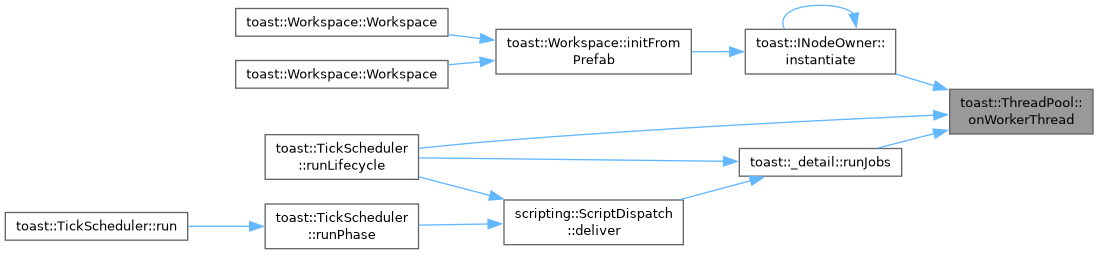
Here is the caller graph for this function:

◆ onWorkerThread()
|
staticnodiscardnoexcept |
- Returns
- true when the calling thread is one of the pool's workers
Here is the caller graph for this function:
◆ push()
template<typename T>
|
static |
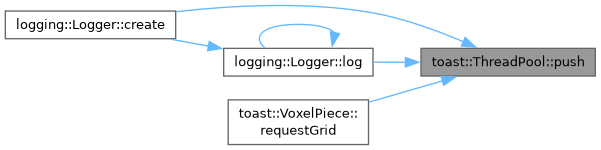
Queues a job for execution by a worker thread.
The job will be executed as soon as a worker thread becomes available. Jobs are processed in FIFO order. The thread pool uses move_only funcions.
- Parameters
-
job The function to execute (moved into the queue)
- Example:
- pool.queueJob([data = std::move(myData)]() {processData(data);});
Here is the caller graph for this function:
◆ waitIdle()
| void toast::ThreadPool::waitIdle | ( | ) |
Blocks the calling thread until all queued and active jobs complete.
More efficient than spinning on busy(); uses a condition variable to sleep until the pool drains completely.
The documentation for this class was generated from the following files:
- engine/src/toast/thread_pool.hpp
- engine/src/toast/thread_pool.cpp