Loading...
Searching...
No Matches
scripting::LuaState Class Reference
Classes | |
| class | Lock |
| Ownership of one interpreter for as long as the object lives. More... | |
| class | NonBlockingScope |
| While one exists on a thread, lock() on that thread never waits. More... | |
Public Member Functions | |
| auto | lock (size_t index) noexcept -> Lock |
| Acquires the interpreter at index for the calling thread. | |
| auto | tryLock (size_t index) noexcept -> Lock |
| Non-blocking variant of lock(). | |
| auto | assign (uint64_t group, std::optional< size_t > forced=std::nullopt) -> size_t |
| Picks the interpreter for a new script runtime. | |
| void | unassign (uint64_t group, size_t index) noexcept |
| Gives back what assign() handed out. | |
| auto | loads () const -> std::vector< uint32_t > |
| How many runtimes every interpreter hosts, for diagnostics and tests. | |
| auto | poolSize () const noexcept -> size_t |
| auto | mainState (size_t index) const noexcept -> lua_State * |
| The main thread of an interpreter; only the owner may touch it. | |
| void | retire (size_t index, std::move_only_function< void()> destroyer) noexcept |
| Runs destroyer while the interpreter index is owned. | |
| auto | contentionCount () const noexcept -> uint64_t |
| How many times a thread that owned an interpreter found another one busy; non zero means work was queued. | |
| auto | waitCount () const noexcept -> uint64_t |
| How many times a thread had to wait for an interpreter that another thread owned. | |
| auto | runString (std::string_view lua_code) noexcept -> bool |
| Runs a chunk on state 0; intended for debug/console use. | |
| auto | runStringOn (size_t index, std::string_view lua_code, std::string *error=nullptr) noexcept -> bool |
| Runs a chunk on the given interpreter. | |
| void | refreshTypeMarkers () noexcept |
| Re-registers the Node/Asset type-marker globals on every state. | |
Static Public Member Functions | |
| static auto | create () noexcept -> std::unique_ptr< LuaState > |
| static auto | get () noexcept -> LuaState & |
| static auto | exists () noexcept -> bool |
| static auto | indexOf (lua_State *state) noexcept -> std::optional< size_t > |
| static auto | ownedByCurrentThread (size_t index) noexcept -> bool |
| True when the calling thread currently owns the interpreter. | |
| static auto | ownedByCurrentThread (lua_State *state) noexcept -> bool |
| static auto | ownsAnyState () noexcept -> bool |
| True when the calling thread owns any interpreter. | |
| static auto | lastOwnedIndex () noexcept -> std::optional< size_t > |
| The interpreter this thread acquired last, if it owns any. | |
| static auto | newGroup () noexcept -> uint64_t |
| Allocates the number of a new script group, never zero. | |
| static void | retireOrLeak (size_t index, std::move_only_function< void()> destroyer) noexcept |
| Like retire(), but once the pool is gone the destroyer is leaked instead of run, the interpreters no longer exist. | |
Static Public Attributes | |
| static constexpr uint32_t | k_group_chunk = 8 |
| How many runtimes of one script group share an interpreter before the next ones go to another. | |
Member Function Documentation
◆ assign()
|
nodiscard |
Picks the interpreter for a new script runtime.
The runtimes of one script group (the nodes of a prefab instance) are kept together, so the calls between their scripts are plain calls that nothing else can be running at the same time. No interpreter hosts more than k_group_chunk of one group though: a group with hundreds of scripts is spread over several, or those scripts could only ever tick one after the other. Runtimes without a group, and every new chunk of a group, go to the least loaded interpreter that has room for them
- Parameters
-
forced Place the runtime there instead, for a thread that owns that interpreter and cannot wait for another
- Note
- Every call has to be paired with unassign() once the runtime is gone
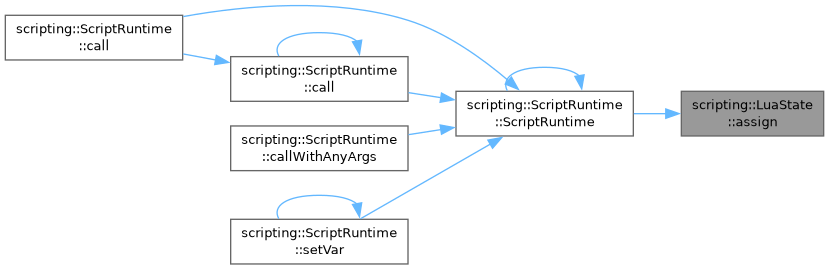
Here is the caller graph for this function:
◆ lock()
|
nodiscardnoexcept |
Acquires the interpreter at index for the calling thread.
Waits for the interpreter only when the calling thread owns no other one. A thread that already owns an interpreter never waits for a second one
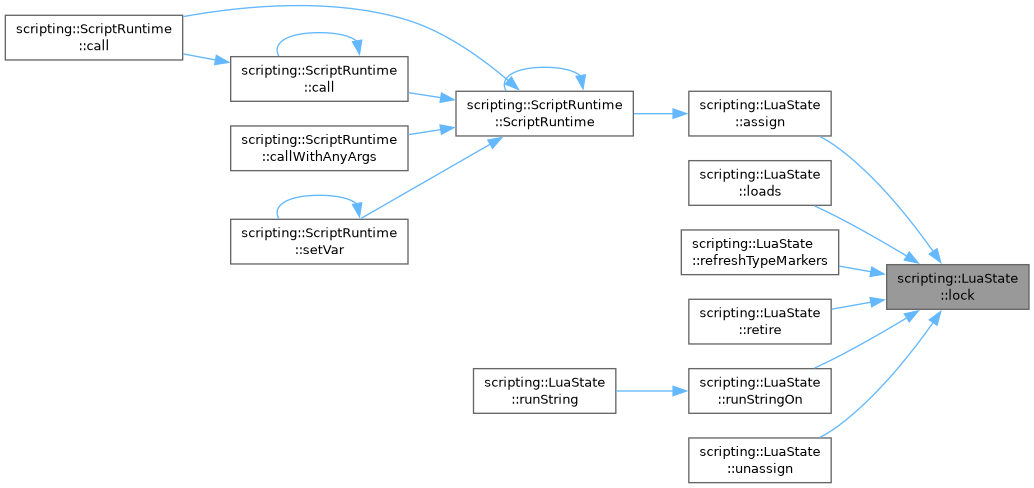
Here is the caller graph for this function:
◆ retire()
|
noexcept |
Runs destroyer while the interpreter index is owned.
Used to release anything that holds a reference inside the interpreter
The documentation for this class was generated from the following files:
- engine/src/toast/scripting/lua_state.hpp
- engine/src/toast/scripting/lua_state.cpp