Loading...
Searching...
No Matches
toast::Box< T > Class Template Reference
Intrusive reference-counted handle to a Node. More...
#include <box.hpp>
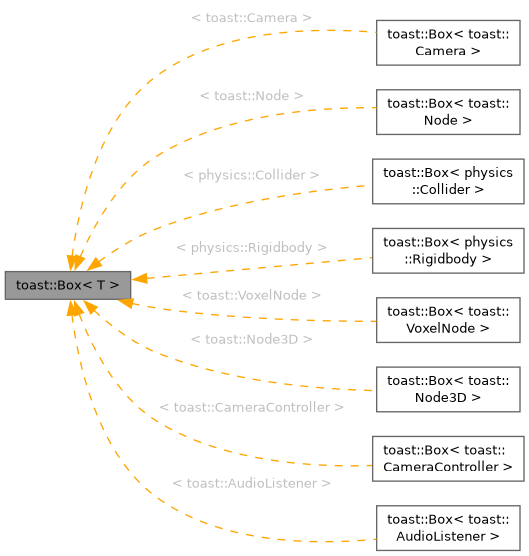
Inheritance diagram for toast::Box< T >:
Public Member Functions | |
| Box () noexcept=default | |
| Default-constructs an empty (null) box; does not allocate anything. | |
| Box (std::nullptr_t) noexcept | |
| Constructs an empty (null) box; equivalent to the default constructor. | |
| Box (_detail::ControlBox *control_box) noexcept | |
| Low-level constructor used internally by the node allocation path; prefer constructing from a Node& or Node*. | |
| Box (const T *node) noexcept | |
| Constructs from a live node pointer; safe to call with null (produces an empty box); increments ref count. | |
| Box (const T &node) noexcept | |
| Constructs from a live node reference; increments ref count. | |
| Box (const Box &other) noexcept | |
| Shares ownership with other; increments ref count. | |
| auto | operator= (const Box &other) noexcept -> Box & |
| Shares ownership with other; increments ref count. | |
| Box (Box &&other) noexcept | |
| Transfers ownership from other; source becomes empty without touching the ref count. | |
| auto | operator= (Box &&other) noexcept -> Box & |
| Transfers ownership from other; source becomes empty without touching the ref count. | |
|
template<typename U> requires std::convertible_to<U*, T*> | |
| Box (const Box< U > &other) noexcept | |
| Derived-type copy; only enabled when U* is implicitly convertible to T*; increments ref count. | |
|
template<typename U> requires std::convertible_to<U*, T*> | |
| auto | operator= (const Box< U > &other) noexcept -> Box & |
| Derived-type copy assignment; only enabled when U* is implicitly convertible to T*. | |
|
template<typename U> requires std::convertible_to<U*, T*> | |
| Box (Box< U > &&other) noexcept | |
| Derived-type move; transfers ownership without touching the ref count. | |
|
template<typename U> requires std::convertible_to<U*, T*> | |
| auto | operator= (Box< U > &&other) noexcept -> Box & |
| Derived-type move assignment. | |
| auto | exists () const noexcept -> bool |
| Whether this box holds a live node. | |
| auto | operator<=> (const Box &other) const noexcept -> std::strong_ordering |
| auto | operator== (const Box &other) const noexcept -> bool |
| operator bool () const noexcept | |
| operator T& () noexcept | |
| auto | operator-> () noexcept -> T * |
| auto | operator* () noexcept -> T & |
| operator const T & () const noexcept | |
| auto | operator-> () const noexcept -> const T * |
| auto | operator* () const noexcept -> const T & |
|
template<typename U> requires std::derived_from<U, T> | |
| auto | as () const noexcept -> Box< U > |
| Downcasts to a derived type; a null Box returns a null Box rather than throwing. | |
| auto | rid () const noexcept -> size_t |
| Raw identity of the underlying ControlBox as a pointer value; stable for the node's lifetime; used as a hash key. | |
Friends | |
| struct | _detail::ControlBox |
Detailed Description
template<typename T>
class toast::Box< T >
class toast::Box< T >
Intrusive reference-counted handle to a Node.
The ControlBox lives inside the Node allocation itself, so all Box<Node> handles that refer to the same node share one reference count without any extra heap allocation. This design also makes the ref-count safe across DLL boundaries, where std::shared_ptr's control block would differ between modules.
A Box is null (empty) when default-constructed or after the node has been freed. Always call exists() before dereferencing.
- Template Parameters
-
T A Node subtype
- See also
- ControlBox, Node
Member Function Documentation
◆ exists()
template<typename T>
|
nodiscardnoexcept |
Whether this box holds a live node.
- Returns
- false if the box is empty or if the node has been freed by World::drainDestroyQueue(); always check exists() before dereferencing
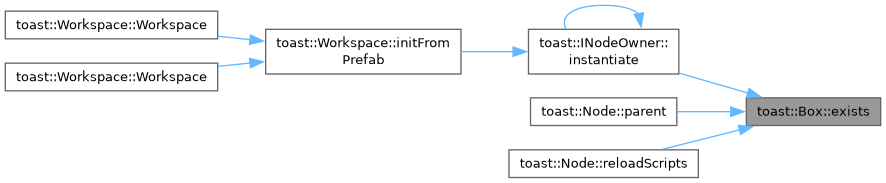
Here is the caller graph for this function:
The documentation for this class was generated from the following files: