Loading...
Searching...
No Matches
toast::Node Class Reference
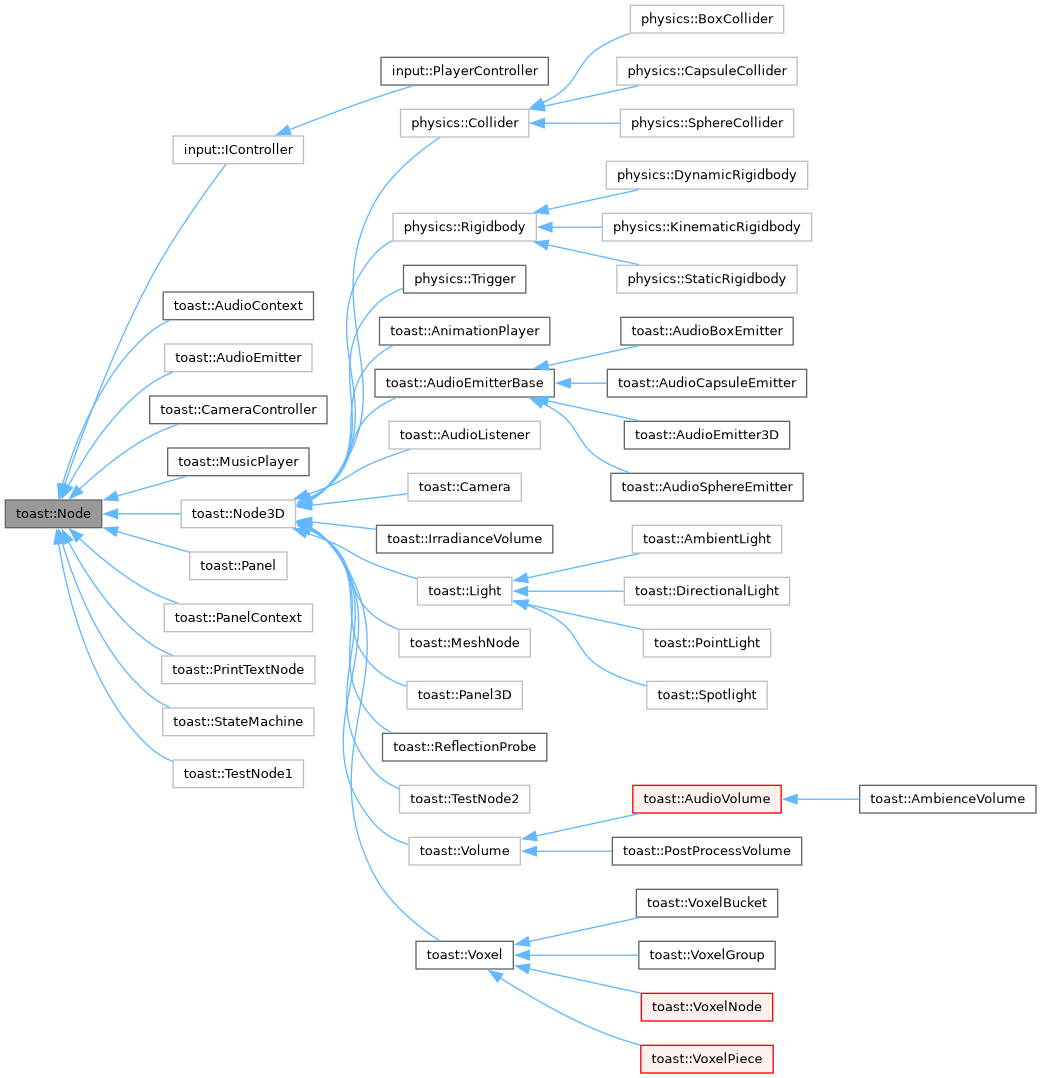
Inheritance diagram for toast::Node:
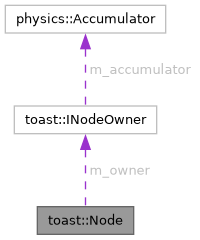
Collaboration diagram for toast::Node:
Public Member Functions | |
| auto | uid () const noexcept -> const UID & |
| Stable unique identifier, assigned at construction or deserialization. Never changes. | |
| auto | rid () const noexcept -> std::uintptr_t |
| Runtime identifier for this node, guaranteed to be unique but changes every time. | |
| auto | name () const noexcept -> std::string_view |
| Display name. Siblings may share one - this is not an identifier. | |
| void | name (std::string_view name) noexcept |
| Sets the display name. | |
| auto | enabled () const noexcept -> bool |
| Whether this node is currently active. | |
| auto | participatesIn (NodeOwnerParticipation use) const noexcept -> bool |
| auto | owner () const noexcept -> INodeOwner * |
| The World or Workspace this node belongs to. | |
| void | enabled (bool value) noexcept |
| Sets the local enabled flag and propagates the change to all children. | |
| auto | box () const noexcept -> Box< Node > |
| Returns an owning handle to this node. | |
| auto | info () const -> const NodeInfo * |
| Reflection metadata registered by the code generator. | |
| auto | sourcePrefab () const noexcept -> const assets::Handle< assets::Prefab > & |
| The prefab this node was instantiated from. | |
| auto | isInstanceRoot () const noexcept -> bool |
| Whether this node is the root of a prefab instance. | |
| auto | root () const noexcept -> Box< Node > |
| The topmost ancestor that is not the world root. | |
| auto | state () const noexcept -> NodeState |
| auto | type () const noexcept -> NodeType |
| auto | listener () noexcept -> event::Listener & |
| The event Listener owned by this node. Lazy-allocated, freed only with the node. | |
| auto | parent () noexcept -> Box< Node > |
| The immediate parent of this node. | |
| auto | children () const noexcept -> const std::vector< Box< Node > > & |
| The ordered list of direct children. | |
| auto | childrenSnapshot () const -> std::vector< Box< Node > > |
| auto | create (std::string_view type="toast::Node") noexcept -> Box< Node > |
| Creates a new child node of the given type and attaches it to this node. | |
| auto | spawn (UID uid) noexcept -> Box< Node > |
| Asynchronously instantiates a prefab as a child of this node. | |
| auto | spawn (std::string_view uri) noexcept -> Box< Node > |
| Asynchronously instantiates a prefab as a child of this node. | |
| auto | find (std::string_view query) -> Box< Node > |
| Depth-first search for a single descendant. | |
| auto | find (const UID &uid) -> Box< Node > |
| Looks up a node by UID within this node's local root. | |
| auto | search (std::string_view query) -> std::vector< Box< Node > > |
| Depth-first search for all matching descendants. | |
| auto | childrenOfType (const NodeInfo *type) const -> std::vector< Box< Node > > |
| auto | searchType (const NodeInfo *type) const -> std::vector< Box< Node > > |
| void | addDependsOn (Node &other) |
| void | removeDependsOn (Node &other) |
| void | interactsWith (Node &other) |
| Declares that the scripts of this node and of other call each other. | |
| auto | scriptRuntime () noexcept -> scripting::ScriptRuntime * |
| auto | hasTickFunction (TickFunctionList mask) const noexcept -> bool |
| auto | scriptVm (TickFunctionList func) const noexcept -> std::optional< size_t > |
| The interpreter this node runs Lua on while it executes func, empty when it runs none. | |
| auto | scriptVmAny () const noexcept -> std::optional< size_t > |
| The interpreter the scripts of this node live on whatever phase they define. | |
| auto | hasCallable (std::string_view name) const noexcept -> bool |
| void | reloadScripts () noexcept |
| Rebuilds the script runtime after a script asset changed (hot reload or attach). | |
| auto | scripts () const noexcept -> const std::vector< assets::Handle< assets::Script > > & |
| void | setScripts (std::vector< assets::Handle< assets::Script > > scripts) noexcept |
| void | addScript (const assets::Handle< assets::Script > &script) noexcept |
| template<typename R = void, typename... Args> | |
| auto | call (std::string_view name, Args &&... args) -> R |
| Invokes all C++ reflected implementations of name (base→derived) and all same-named Lua functions across every attached script, forwarding args. | |
| template<typename T> | |
| auto | get (std::string_view name) const -> T |
| Reads a named value: reflected C++ field first, then the first matching Lua instance variable. | |
| template<typename T> | |
| void | set (std::string_view name, const T &value) |
| Writes a named value: reflected C++ field if present and every Lua instance variable of that name that already exists. | |
| auto | isRecursivePrefab () const noexcept -> bool |
Public Attributes | |
| signals::Signal< Box< Node > > | on_enable |
| signals::Signal< Box< Node > > | on_disable |
| signals::Signal< Box< Node > > | on_begin |
| signals::Signal< Box< Node > > | on_end |
Protected Member Functions | |
| virtual void | onReflectedFieldChanged (std::string_view) |
| virtual void | onScriptsReloaded () |
| virtual void | onScriptsReloading () |
| virtual auto | luaAffinity () const noexcept -> std::optional< size_t > |
| virtual void | onScriptVarChanged (std::string_view path) |
| virtual void | updateInspectorMessages () |
| void | addInspectorMessage (const NodeMessage &message) |
| void | removeInspectorMessage (const NodeMessage &message) |
Protected Attributes | |
| INodeOwner * | m_owner = nullptr |
Member Function Documentation
◆ addScript()
|
inlinenoexcept |
Attaches a script at the end and rebuilds the script runtime
◆ box()
|
nodiscardnoexcept |
Returns an owning handle to this node.
- Returns
- A Box<Node> that shares ownership; always valid while the node exists; safe to store
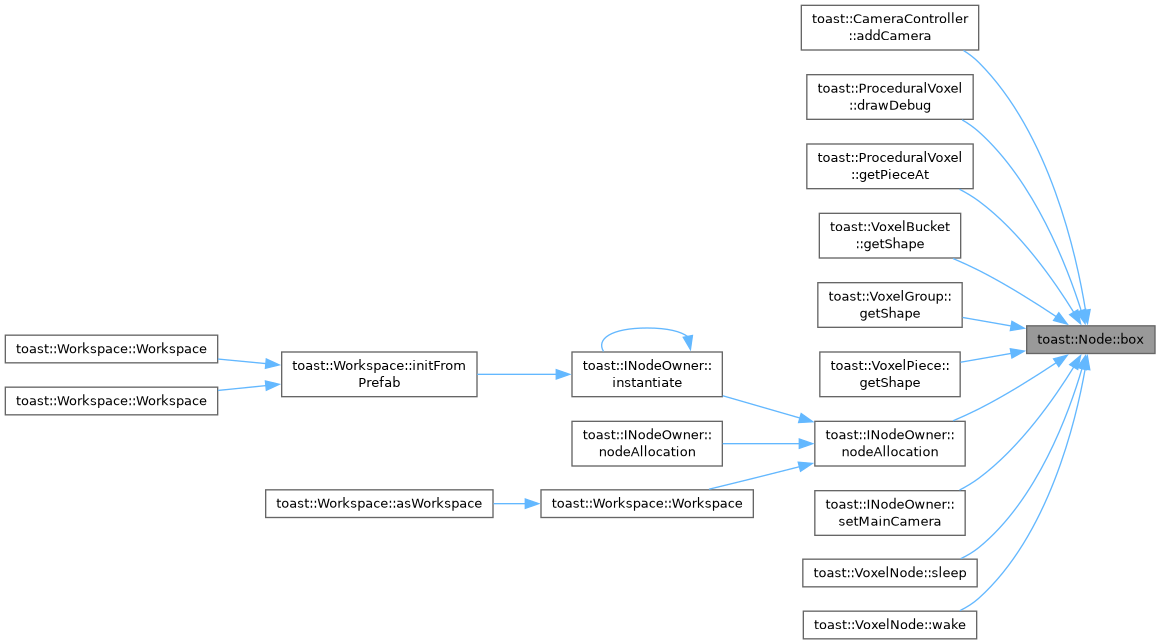
Here is the caller graph for this function:
◆ call()
template<typename R = void, typename... Args>
|
inline |
Invokes all C++ reflected implementations of name (base→derived) and all same-named Lua functions across every attached script, forwarding args.
- Template Parameters
-
R Return type, for non-void the most-derived C++ return value is returned
◆ children()
|
inlinenodiscardnoexcept |
The ordered list of direct children.
- Returns
- Const reference to the internal children vector
- Warning
- Do not store raw pointers or references into this vector; it may reallocate when children are added or removed
Here is the caller graph for this function:
◆ create()
|
inlinenoexcept |
Creates a new child node of the given type and attaches it to this node.
- Parameters
-
type Fully-qualified C++ class name, e.g. "toast::Node3D"; defaults to "toast::Node"
- Returns
- The new child node, or an empty box if the type is not registered
- Note
- Only valid on nodes in the root or global state; calls the child's init lifecycle
Here is the caller graph for this function:
◆ enabled() [1/2]
|
nodiscardnoexcept |
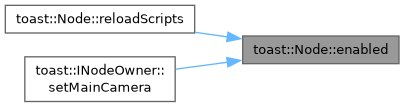
Whether this node is currently active.
- Returns
- false if either the local enabled flag or any ancestor's flag is false; nodes in the cached state are always disabled
Here is the caller graph for this function:
◆ enabled() [2/2]
|
noexcept |
Sets the local enabled flag and propagates the change to all children.
- Parameters
-
value Passing false disables the entire subtree without unregistering event callbacks
◆ find() [1/2]
◆ find() [2/2]
|
nodiscard |
Depth-first search for a single descendant.
- Parameters
-
query A bare name, a slash-separated path, or a node:// URI with namespace keywords: root, world, global
- Returns
- The first match, or an empty box if nothing was found
- Note
- Traversal stops at prefab-instance boundaries; interior nodes are opaque to find()
- See also
- search()
Here is the caller graph for this function:

◆ get()
template<typename T>
|
inlinenodiscard |
Reads a named value: reflected C++ field first, then the first matching Lua instance variable.
- Returns
- The field/variable value cast to T, or T{} on void
◆ hasCallable()
|
nodiscardnoexcept |
- Returns
- true when a reflected C++ or Lua function exists
◆ hasTickFunction()
|
nodiscardnoexcept |
- Returns
- true if this node implements any of the given tick functions in C++ or Lua
◆ info()
|
nodiscard |
Reflection metadata registered by the code generator.
- Returns
- Pointer to the static NodeInfo for this type, or nullptr for a bare Node instance that was never registered with NodeRegistry
- See also
- NodeRegistry::reflect()
◆ isInstanceRoot()
|
nodiscardnoexcept |
◆ luaAffinity()
|
inlinenodiscardprotectedvirtualnoexcept |
Reimplemented in toast::StateMachine.
◆ name()
|
noexcept |
Sets the display name.
- Parameters
-
name New name; copied internally
◆ onScriptsReloading()
|
inlineprotectedvirtual |
Runs right before the script runtime is torn down and built again
Reimplemented in toast::VoxelPiece.
◆ onScriptVarChanged()
|
inlineprotectedvirtual |
A script variable was edited from outside the script, path is "<instance>:<group/name>"
Reimplemented in toast::VoxelPiece.
◆ owner()
|
inlinenodiscardnoexcept |

◆ parent()
|
nodiscardnoexcept |
The immediate parent of this node.
- Returns
- An empty box if this node is a root or world root
◆ root()
|
nodiscardnoexcept |
The topmost ancestor that is not the world root.
- Returns
- An empty box if this node itself is a root node
◆ scripts()
|
inlinenodiscardnoexcept |
The scripts attached to this node in call order
Here is the caller graph for this function:

◆ scriptVm()
|
nodiscardnoexcept |
The interpreter this node runs Lua on while it executes func, empty when it runs none.
That is the interpreter of its own scripts when they define func, or, for a C++ node that calls functions a script gave it, the one those functions live on, see luaAffinity()
The scheduler keeps everything that shares an interpreter so two threads dont want the same interpreter
◆ search()
|
nodiscard |
◆ setScripts()
|
inlinenoexcept |
Replaces every script and rebuilds the script runtime
Here is the caller graph for this function:

◆ sourcePrefab()
|
nodiscardnoexcept |
The prefab this node was instantiated from.
- Returns
- An empty Handle for nodes created at runtime
◆ spawn() [1/2]
|
inlinenoexcept |
Asynchronously instantiates a prefab as a child of this node.
- Parameters
-
uri Virtual URI of the prefab asset, e.g. "assets://characters/knight.node"
- Returns
- An empty box immediately; the child appears at the start of the next frame
- Note
- Only valid on root or global nodes; each instance receives a fresh UID
◆ spawn() [2/2]
◆ state()
|
inlinenodiscardnoexcept |
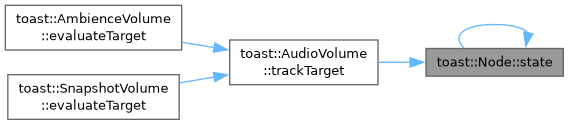
- Returns
- The current NodeState (null, loading, cached, root, global, or destroy)
Here is the caller graph for this function:
◆ type()
|
inlinenodiscardnoexcept |
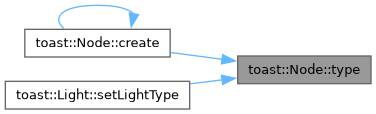
- Returns
- The current NodeType (null, child, root, or world_root)
Here is the caller graph for this function:
The documentation for this class was generated from the following files:
- engine/src/toast/world/node.hpp
- engine/src/toast/world/node.cpp