Loading...
Searching...
No Matches
toast::ReflectionProbe Class Reference
A volume in which reflections are reprojected onto local geometry instead of infinity. More...
#include <reflection_probe.hpp>
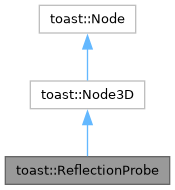
Inheritance diagram for toast::ReflectionProbe:
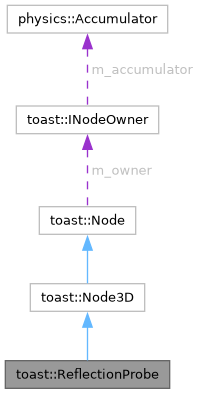
Collaboration diagram for toast::ReflectionProbe:
Public Member Functions | |
| auto | influenceRadius () const noexcept -> float |
| auto | boxExtents () const noexcept -> const glm::vec3 & |
| auto | intensity () const noexcept -> float |
| auto | usesBoxProjection () const noexcept -> bool |
| auto | resolution () const noexcept -> uint32_t |
| auto | isPrebaked () const noexcept -> bool |
| Public Member Functions inherited from toast::Node3D | |
| auto | raycast (glm::vec3 dir, glm::vec3 offset=glm::vec3(0.0f), float max_distance=-1.0f, bool ignore_self=true, const std::vector< int > &layers=std::vector< int > {}) const -> std::optional< physics::RayHit > |
| The nearest thing a ray from this node hits. | |
| auto | raymulticast (glm::vec3 dir, glm::vec3 offset=glm::vec3(0.0f), float max_distance=-1.0f, int max_hits=-1, bool ignore_self=true, const std::vector< int > &layers=std::vector< int > {}) const -> std::vector< physics::RayHit > |
Up to max_hits things collisions. | |
| auto | linecast (glm::vec3 from, glm::vec3 to, int max_hits=-1, bool ignore_self=true, const std::vector< int > &layers=std::vector< int > {}) const -> std::vector< physics::RayHit > |
Everything on the line between two points, nearest to from first. | |
| void | lookAt (glm::vec3 target, glm::vec3 up={0.0f, 0.0f, 1.0f}) |
| Orients the node so its forward axis points at a world-space target. | |
| void | lookAtZ (glm::vec3 target) |
| lookAt() constrained to the XY plane; the node faces the target with no roll | |
| auto | up () const -> glm::vec3 |
| auto | forward () const -> glm::vec3 |
| void | syncTransform () const |
| void | syncWorldTransform () const |
| void | refreshTransformParent () |
| auto | getTransform () const noexcept -> const glm::mat4 & |
| auto | getWorldTransform () const noexcept -> const glm::mat4 & |
| virtual void | onEditorTransformChanged () |
| Public Member Functions inherited from toast::Node | |
| auto | uid () const noexcept -> const UID & |
| Stable unique identifier, assigned at construction or deserialization. Never changes. | |
| auto | rid () const noexcept -> std::uintptr_t |
| Runtime identifier for this node, guaranteed to be unique but changes every time. | |
| auto | name () const noexcept -> std::string_view |
| Display name. Siblings may share one - this is not an identifier. | |
| void | name (std::string_view name) noexcept |
| Sets the display name. | |
| auto | enabled () const noexcept -> bool |
| Whether this node is currently active. | |
| auto | participatesIn (NodeOwnerParticipation use) const noexcept -> bool |
| auto | owner () const noexcept -> INodeOwner * |
| The World or Workspace this node belongs to. | |
| void | enabled (bool value) noexcept |
| Sets the local enabled flag and propagates the change to all children. | |
| auto | box () const noexcept -> Box< Node > |
| Returns an owning handle to this node. | |
| auto | info () const -> const NodeInfo * |
| Reflection metadata registered by the code generator. | |
| auto | sourcePrefab () const noexcept -> const assets::Handle< assets::Prefab > & |
| The prefab this node was instantiated from. | |
| auto | isInstanceRoot () const noexcept -> bool |
| Whether this node is the root of a prefab instance. | |
| auto | root () const noexcept -> Box< Node > |
| The topmost ancestor that is not the world root. | |
| auto | state () const noexcept -> NodeState |
| auto | type () const noexcept -> NodeType |
| auto | listener () noexcept -> event::Listener & |
| The event Listener owned by this node. Lazy-allocated, freed only with the node. | |
| auto | parent () noexcept -> Box< Node > |
| The immediate parent of this node. | |
| auto | children () const noexcept -> const std::vector< Box< Node > > & |
| The ordered list of direct children. | |
| auto | childrenSnapshot () const -> std::vector< Box< Node > > |
| auto | create (std::string_view type="toast::Node") noexcept -> Box< Node > |
| Creates a new child node of the given type and attaches it to this node. | |
| auto | spawn (UID uid) noexcept -> Box< Node > |
| Asynchronously instantiates a prefab as a child of this node. | |
| auto | spawn (std::string_view uri) noexcept -> Box< Node > |
| Asynchronously instantiates a prefab as a child of this node. | |
| auto | find (std::string_view query) -> Box< Node > |
| Depth-first search for a single descendant. | |
| auto | find (const UID &uid) -> Box< Node > |
| Looks up a node by UID within this node's local root. | |
| auto | search (std::string_view query) -> std::vector< Box< Node > > |
| Depth-first search for all matching descendants. | |
| auto | childrenOfType (const NodeInfo *type) const -> std::vector< Box< Node > > |
| auto | searchType (const NodeInfo *type) const -> std::vector< Box< Node > > |
| void | addDependsOn (Node &other) |
| void | removeDependsOn (Node &other) |
| void | interactsWith (Node &other) |
| Declares that the scripts of this node and of other call each other. | |
| auto | scriptRuntime () noexcept -> scripting::ScriptRuntime * |
| auto | hasTickFunction (TickFunctionList mask) const noexcept -> bool |
| auto | scriptVm (TickFunctionList func) const noexcept -> std::optional< size_t > |
| The interpreter this node runs Lua on while it executes func, empty when it runs none. | |
| auto | scriptVmAny () const noexcept -> std::optional< size_t > |
| The interpreter the scripts of this node live on whatever phase they define. | |
| auto | hasCallable (std::string_view name) const noexcept -> bool |
| void | reloadScripts () noexcept |
| Rebuilds the script runtime after a script asset changed (hot reload or attach). | |
| auto | scripts () const noexcept -> const std::vector< assets::Handle< assets::Script > > & |
| void | setScripts (std::vector< assets::Handle< assets::Script > > scripts) noexcept |
| void | addScript (const assets::Handle< assets::Script > &script) noexcept |
| template<typename R = void, typename... Args> | |
| auto | call (std::string_view name, Args &&... args) -> R |
| Invokes all C++ reflected implementations of name (base→derived) and all same-named Lua functions across every attached script, forwarding args. | |
| template<typename T> | |
| auto | get (std::string_view name) const -> T |
| Reads a named value: reflected C++ field first, then the first matching Lua instance variable. | |
| template<typename T> | |
| void | set (std::string_view name, const T &value) |
| Writes a named value: reflected C++ field if present and every Lua instance variable of that name that already exists. | |
| auto | isRecursivePrefab () const noexcept -> bool |
Additional Inherited Members | |
| Public Attributes inherited from toast::Node3D | |
| glm::vec3 | position = glm::vec3(0.0f) |
| glm::quat | rotation = glm::quat(1.0f, 0.0f, 0.0f, 0.0f) |
| glm::vec3 | scale = glm::vec3(1.0f) |
| glm::vec3 | world_position = glm::vec3(0.0f) |
| glm::quat | world_rotation = glm::quat(1.0f, 0.0f, 0.0f, 0.0f) |
| glm::vec3 | world_scale = glm::vec3(1.0f) |
| Public Attributes inherited from toast::Node | |
| signals::Signal< Box< Node > > | on_enable |
| signals::Signal< Box< Node > > | on_disable |
| signals::Signal< Box< Node > > | on_begin |
| signals::Signal< Box< Node > > | on_end |
| Static Public Attributes inherited from toast::Node3D | |
| static const glm::vec3 | world_up = {0.0f, 0.0f, 1.0f} |
| static const glm::vec3 | world_forward = {0.0f, 1.0f, 0.0f} |
| Z axis. | |
| static const glm::vec3 | world_right = {1.0f, 0.0f, 0.0f} |
| Y axis. | |
| Protected Member Functions inherited from toast::Node3D | |
| void | init () |
| X axis. | |
| Protected Member Functions inherited from toast::Node | |
| virtual void | onReflectedFieldChanged (std::string_view) |
| virtual void | onScriptsReloaded () |
| virtual void | onScriptsReloading () |
| virtual auto | luaAffinity () const noexcept -> std::optional< size_t > |
| virtual void | onScriptVarChanged (std::string_view path) |
| virtual void | updateInspectorMessages () |
| void | addInspectorMessage (const NodeMessage &message) |
| void | removeInspectorMessage (const NodeMessage &message) |
| Protected Attributes inherited from toast::Node | |
| INodeOwner * | m_owner = nullptr |
Detailed Description
A volume in which reflections are reprojected onto local geometry instead of infinity.
An environment cubemap is infinitely distant by construction: every surface in the world reflects it as though the room were unbounded, so a wall two metres away and the sky behind it arrive from the same direction. Indoors that reads as wrong immediately - reflections slide across surfaces as the camera moves rather than staying attached to the geometry that should be producing them
A probe fixes that by describing the shape of the space it covers. The reflection ray is intersected against that shape and re-aimed at the hit point, so a reflection lands on the wall it belongs to. Where probes do not reach, shading falls back to the global environment, which is why the whole thing degrades gracefully rather than popping
- Note
- A probe reprojects its own captured cubemap once baked, and the global environment until then - so an unbaked probe still corrects the shape of reflections, just not their content
Member Function Documentation
◆ boxExtents()
|
inlinenodiscardnoexcept |
- Returns
- half-extents of the box the reflection ray is intersected against
◆ influenceRadius()
|
inlinenodiscardnoexcept |
- Returns
- radius at which this probe stops contributing entirely
◆ isPrebaked()
|
inlinenodiscardnoexcept |
- Returns
- true when this probe loads its capture from disk rather than baking it each run
◆ resolution()
|
inlinenodiscardnoexcept |
- Returns
- face resolution of this probe's cubemap, clamped to what the pass supports
The documentation for this class was generated from the following files:
- engine/src/toast/world/reflection_probe.hpp
- engine/src/toast/world/reflection_probe.cpp